REVIEW · TIRANA
Tour a Piedi di Tirana
Book on Viator →Operated by Tirana Walking Tours · Bookable on Viator
Tirana makes sense on foot. This walking tour threads the city’s big landmarks into one easy loop, with a guide who explains what you’re seeing and why it matters. You’ll cover royal-meets-modern symbols, Ottoman-era worship spaces, and the sharper edges of Albania’s 20th-century story—without needing a car.
I especially like the licensed English and Italian speaking guide. Names like Martin and Ilir show up in recent outings, and the common theme is clear: you can ask questions and you’ll get straight answers, not rehearsed lines. I also like the value—everything here is priced low for a 2.5-hour orientation walk, and the stops are listed as admission-free.
One thing to consider: you’re outside for most of the time, and the experience is described as requiring good weather. Also, while most groups go smoothly, there are a small number of negative reports about the guide not being at the meeting point, so show up a few minutes early and keep your booking details handy.
In This Review
- Key things I’d circle before you go
- From Et’hem Bej Mosque to Skanderbeg Square: where the story starts
- What to watch for
- Bunk’Art 2 and the Fortress of Justinian: Tirana’s layers in plain language
- Small caution
- Parliament, Namazgah, Saint Paul: religion and politics side-by-side
- Practical tip for this section
- Enver Hoxha’s Pyramid and Postbllok: the dictatorship section you won’t forget
- The vibe check
- Tanners’ Bridge, Taiwan Pool, and the House of Leaves: the lighter surprises
- Who tends to enjoy these stops
- Price and logistics: what you’re really paying for
- The only real risk: meeting-point mismatch
- Should you book Tour a Piedi di Tirana?
- FAQ
- How long is Tour a Piedi di Tirana?
- Where does the tour start and end?
- What languages are the guides?
- Is admission included for the stops?
- Is transportation included?
- Are service animals allowed?
- Should you book Tour a Piedi di Tirana?
Key things I’d circle before you go
- A tight 2.5-hour loop that gets you oriented fast in Tirana
- English/Italian licensed guides (Martin and Ilir are examples from recent groups)
- Free admission at every major stop listed on the route
- Cold War and dictatorship-era sites: the Pyramid, Postbllok checkpoint, and Enver Hoxha’s residence
- Religious variety in a single walk: mosques plus the Saint Paul Cathedral area and an Orthodox church
- Small group feel with a maximum of 25 people, plus a mobile ticket
From Et’hem Bej Mosque to Skanderbeg Square: where the story starts
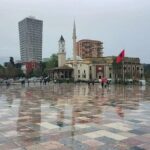
The tour begins at Et’hem Bej Mosque (Sheshi Skënderbej 1). I like that choice because it drops you right into the city’s public-center energy from the first minute, so you’re not wandering around guessing what’s important.
If you’re arriving in Tirana and want to understand the layout quickly, this is exactly the kind of start that helps. You’ll spend time at Skanderbeg Square to get your bearings—who Skanderbeg is, why the square matters, and how it connects to Albania’s identity. Even if you only catch a few details, the square gives you a visual anchor for everything else you’ll see later.
Then you circle back for Et’hem Bej Mosque, where you’ll get an explanation of the site rather than just a photo-op. The practical benefit: you’ll know what to look for instead of treating it like another stop on a checklist. If you’re the type who likes to visit religious places respectfully, this format helps you slow down and notice more.
Other walking tours of Tirana worth a look


What to watch for
Mosques and churches are active or culturally significant places, so plan to be mindful with clothing and behavior. The tour is short on time, so bring water and wear shoes that can handle lots of pavement and sidewalks.
Bunk’Art 2 and the Fortress of Justinian: Tirana’s layers in plain language
Next comes Bunk’Art 2, paired with context about BunkArt 1. Even without leaning on heavy theory, this is a smart pivot point: the tour starts shifting from symbols and squares to Albania’s more complicated 20th-century chapters.
I like how this stop sets up the rest of the walk. You’re not just seeing buildings; you’re learning the meaning behind the way the city stores memory—through museums and preserved reminders. If you’ve heard vague things about Albania’s recent past, this is where you’ll start turning those rumors into something concrete.
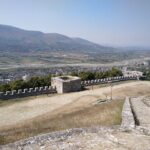
After that, you’ll head to the Fortress of Justinian, explained as the ruins of Tirana castle. Ruins are tricky: you can walk right past them and miss the story. Here, the guide’s job is to translate what’s left into what it used to mean—so those broken stones don’t feel random.
Small caution
Ruins can be uneven underfoot. Keep an eye on where you step, especially if you’re traveling in the warmer months and the sidewalks feel a bit slick.
Parliament, Namazgah, Saint Paul: religion and politics side-by-side
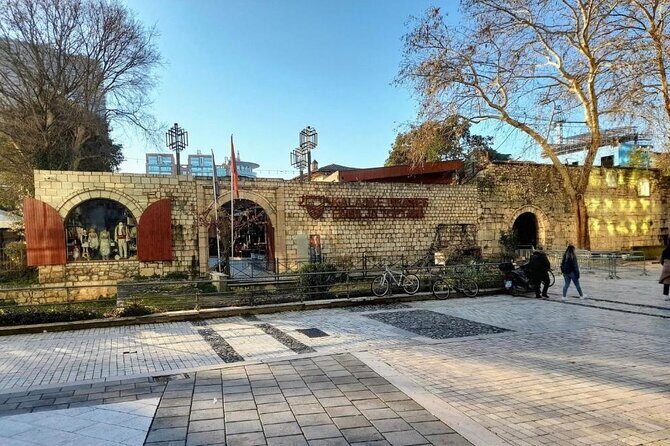
At Parliament of Albania, you’ll get an explanation tied to Albania’s politic situation. I like that the tour doesn’t isolate politics into a “history lecture” corner. You see the governmental space and then get the human-level context that helps you read the city today.
Then the walk swings toward faith with the Mosque of Namazgah, presented as the biggest mosque in the Balkans. Scale matters here. When you stand near something that large, you finally understand why it’s a landmark, not just an address.
After that, you’ll go to Saint Paul Cathedral, where the guide explains religion in Albania. This is a good pairing with Namazgah because it forces you to compare how different traditions show up in the city’s architecture and public presence. You end up with a more balanced mental map of Tirana than if you only focus on one type of building.

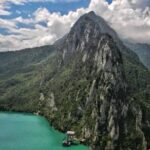
Practical tip for this section
Bring curiosity. The stops are listed as short (about 10 minutes each), so the guide does a lot of work quickly. If you want a deeper answer, ask a question—this tour’s format is built for that.
Enver Hoxha’s Pyramid and Postbllok: the dictatorship section you won’t forget
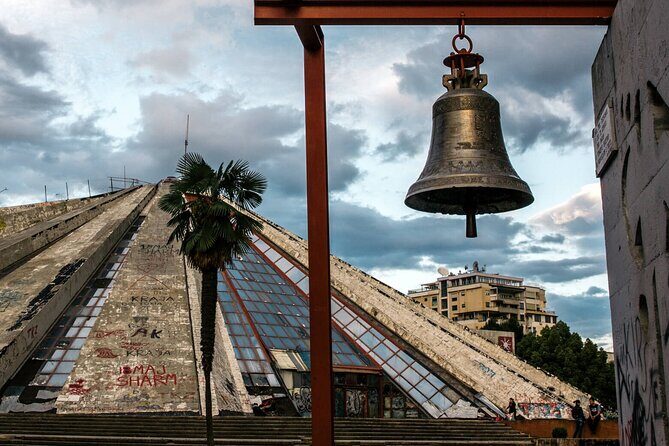
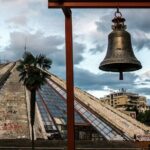
This is one of the most compelling parts of the route. At Enver Hoxha Pyramid, you’ll hear about it as the dictator pyramid. I find it useful to learn the basic backstory before you look at the structure, because otherwise you only see a weird shape in the distance.
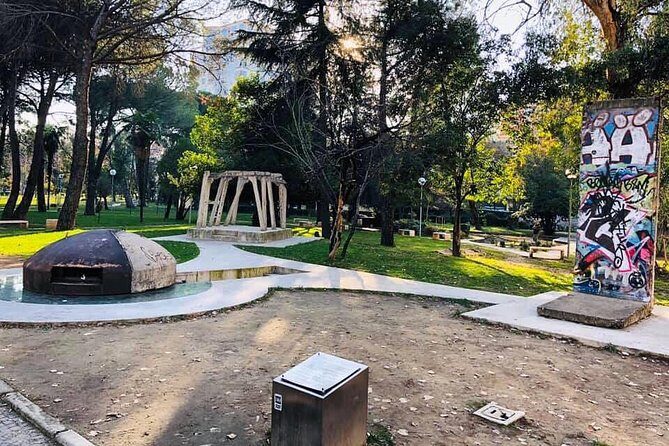
Right after, you’ll visit Postbllok – Checkpoint Monument, explained as a memorial connected to a checkpoint. This is where the story turns from monuments into the feeling of a system—rules you can’t ignore and borders you can’t cross easily.
Then there’s a dedicated explanation for the Bllok area. I like that the tour doesn’t stop at one object. It helps you understand how an area’s reputation forms, and how people experience politics in everyday geography.
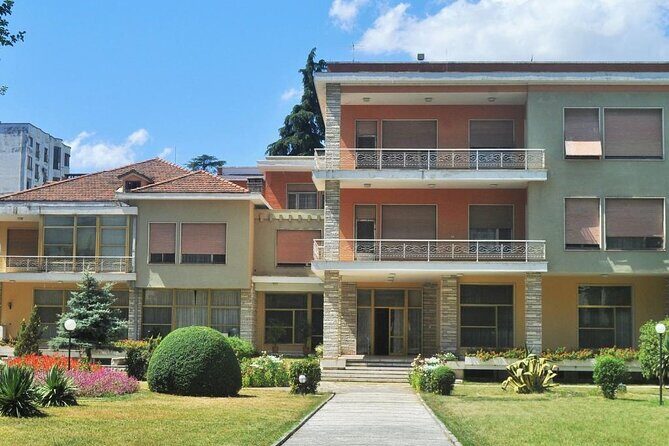
Finally in this arc, you’ll go to Enver Hoxha’s Former Residence, explained as the dictator’s home. It’s a hard stop if you’re sensitive to the subject, but it’s also one of the clearest ways to grasp how power was expressed in physical space.
The vibe check
This part of Tirana can feel heavier than the earlier squares and mosques. If you prefer upbeat travel, pace yourself and use the questions to steer the conversation toward what Albania is becoming, not only what it went through.
Tanners’ Bridge, Taiwan Pool, and the House of Leaves: the lighter surprises
Not every stop is solemn. Tanners’ Bridge gets a focused explanation of the bridge itself—exactly the kind of information that makes older structures feel alive. Bridges are also easy to “read” from a walking tour because you can see how water, streets, and movement connect.
Next is Taiwan Pool (Pishina Taiwan), explained as part of the youth park and the Taiwan center in Tirana. This one is interesting because it shows how international relationships and community space can end up embedded in a city map. You’re not only learning about governments; you’re learning about the places where people spend time.
Then comes the Orthodox Autocephalous Church of Albania, with an explanation of the Orthodox church. Again, you’re building a picture of faith across denominations, not just collecting a handful of impressive buildings.
Finally, you’ll reach the House of Leaves, explained as the site known by that name. I don’t want to overpromise details that aren’t stated in the tour description, but I can tell you the structure of the stop is designed to make you understand why it has the nickname and what it symbolizes for locals.
Who tends to enjoy these stops
If you like contrast—squares and ruins, then leisure spaces and odd architectural names—this last stretch is satisfying. It also breaks up the heavier political sites so your brain can reset.
Price and logistics: what you’re really paying for
The price is $20.93 per person for an experience listed around 2 hours 30 minutes. In my view, the value comes from two things: you get a guided narrative across multiple major parts of Tirana, and the stops are marked as admission ticket free.
You also get English and Italian speaking licensed guide service, plus a mobile ticket. That matters more than it sounds. A walk like this only works if the guide can connect dots fast—between squares, mosques, museums, and memorials—and the language support helps you keep up.
A few more practical notes:
- The tour has a maximum of 25 travelers, so it doesn’t feel like a herd.
- It’s described as near public transportation, which is helpful if you’re juggling other plans that day.
- Private transportation is not included, so you’ll likely be walking between areas and using transit on your own.
One last logistics note: booking is often done about 17 days in advance. If you’re traveling at a busy time, lock it in early and don’t wait for the day-of “maybe.”
The only real risk: meeting-point mismatch
Most of what’s described here points to an organized, small-group walk. But there are also a couple of negative reports about the guide not showing at the meeting point. I can’t predict if that will happen to you, but I can help you reduce the odds.
Show up a bit early at Sheshi Skënderbej 1 and keep your confirmation details ready on your phone. If your group splits by language, don’t panic—an English-speaking guide can explain in a way that supports the whole group.
And if the weather looks sketchy, remember this is described as requiring good weather. Build a flexible plan for your afternoon if you’re visiting in a season where rain surprises you.
Should you book Tour a Piedi di Tirana?
I think you should book this tour if you want a fast, walkable way to understand Tirana’s big contrasts: government and faith, memorials and museums, and even some quirky local landmarks. It’s reasonably priced, designed for orientation, and built for short explanations that you can actually digest while walking.
You might skip it if you hate time limits and prefer long museum visits. The stops are short, so you’ll get explanations, not full deep-dive experiences. Also, if you’re highly risk-averse about meeting points, plan to arrive early and double-check your start location at Et’hem Bej Mosque.
If you want, tell me when you’re visiting and what you already plan to see (just a couple of key sights). I’ll suggest a simple day structure around this 2.5-hour walk so it fits cleanly.
FAQ
How long is Tour a Piedi di Tirana?
The tour lasts about 2 hours 30 minutes.
Where does the tour start and end?
It starts at Et’hem Bej Mosque (Sheshi Skënderbej 1, Tiranë 1001, Albania) and ends back at the same meeting point.
What languages are the guides?
The tour includes an English and Italian speaking licensed guide.
Is admission included for the stops?
Yes. The tour details list each stop as having free admission tickets.
Is transportation included?
No. Private transportation is not included.
Are service animals allowed?
Yes, service animals are allowed.
Should you book Tour a Piedi di Tirana?
Book it if you want a low-cost, small-group walk that helps you connect Tirana’s main squares, mosques, museums, and Enver Hoxha-era sites into one clear mental map. If you’re okay with about 2.5 hours outside and you like having a guide explain what you’re seeing, it’s an efficient first-day style activity.